Artifacts Uncovered: Norman Bruce Family Silver Creamer
Artifacts Uncovered: Norman Bruce Family Silver Creamer
By John Laycock
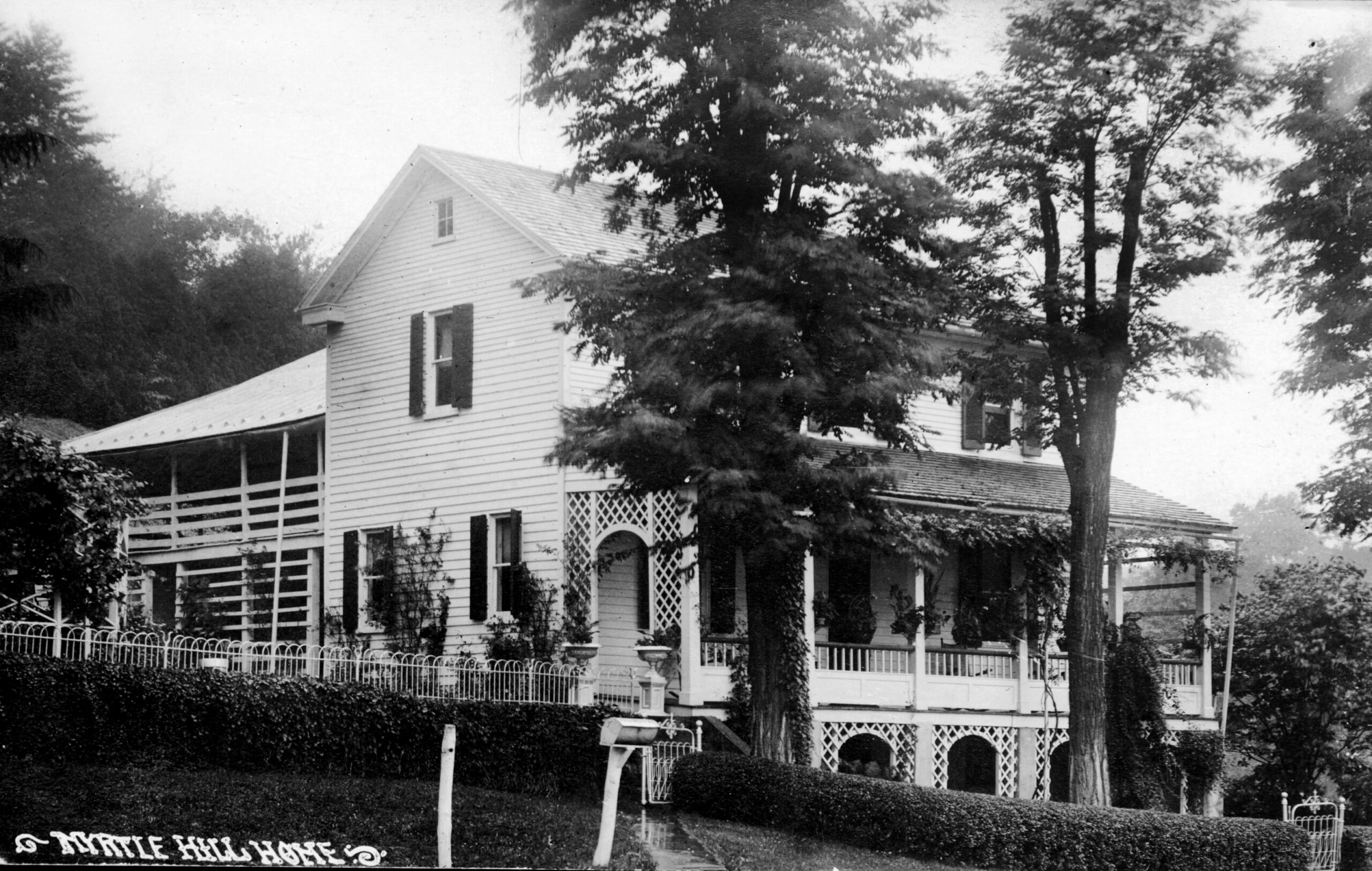
Susannah Gardiner Key Neal is a native Carroll Countian with ties in the area going back multiple generations. She was named for her 4x great grandmother, Susannah Gardiner (Key) Bruce who was born in St. Mary’s County in 1742. Her grandmother married a Scotsman named Normand Bruce and they moved to then Frederick County in the 1760’s where they built a house south of Taneytown next to Big Pipe Creek. That house, known as Myrtle Hill, still stands and has stood the test of time for over 250 years.
After the Bruce family sold the house, many other families lived there through the years. The house may no longer be in the family, it’s hard to continue that legacy across several generations, but its legacy looms large. This is a house where babies were born, children grew up, weddings were celebrated, and deaths mourned. Myrtle Hill literally weathered the elements such as the Great Chesapeake Bay Hurricane of 1769, the Great Blizzard of 1888, Hurricane Agnes in 1972 and more recently Snowmageddon in 2010. It survived the Revolutionary War, the War of 1812, and the Civil War. In a way, Myrtle Hill has lived its own life, many times over.
Last summer Susannah Neal returned to visit the house where her ancestors lived. She was accompanied by her niece Rose, Rose’s children, a newly met cousin Barbara, and Myrtle Hill’s current owner Suzanne Folk. The visit allowed Susannah to cross through the same doorway that her ancestors opened. She gazed out the same windows as her ancestors did so long ago. She walked in the same yard that her ancestors walked. Visiting Mrytle Hill allowed Susannah to make meaningful and profound family history connections.
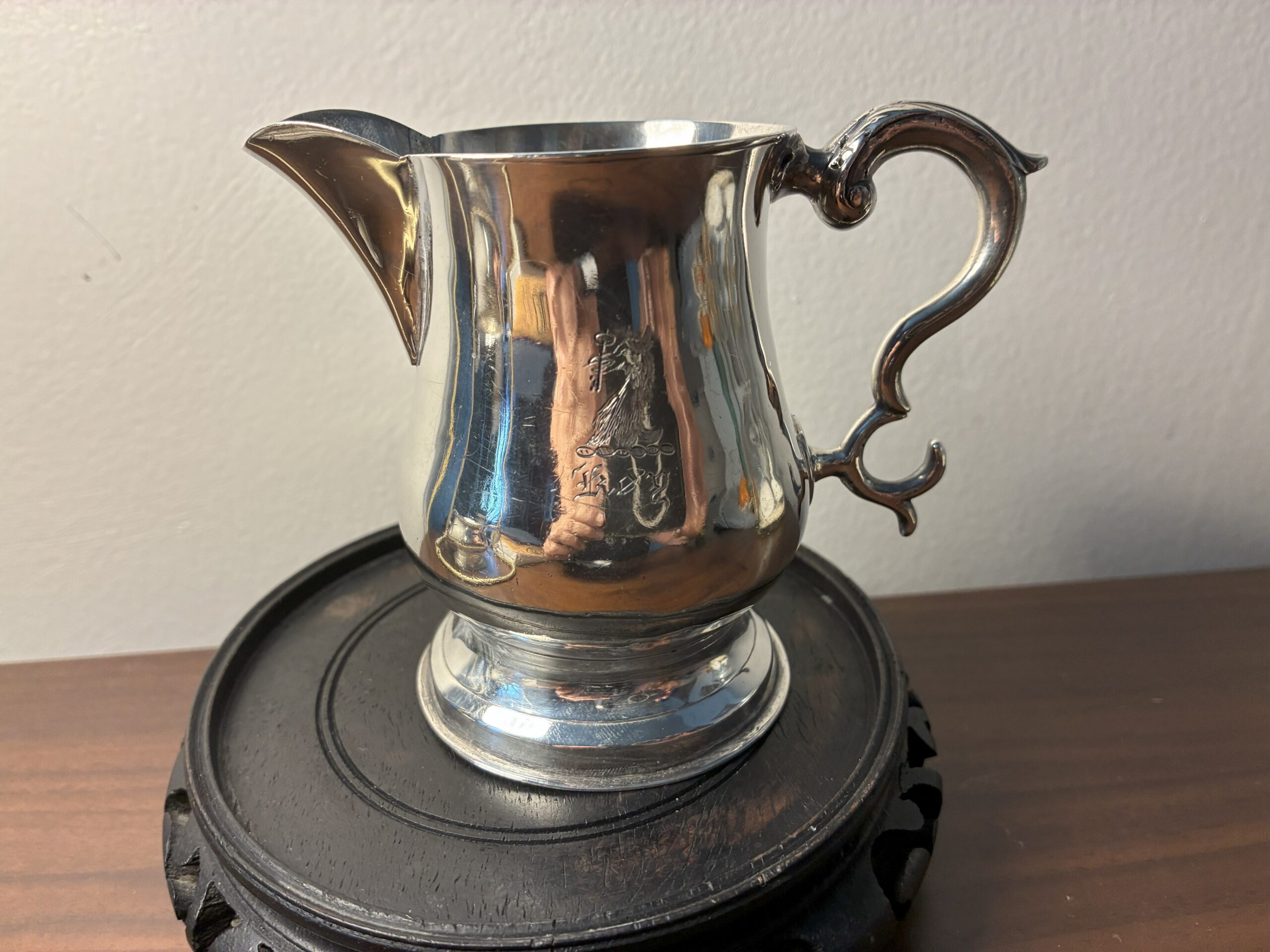
Susannah’s grandfather was Norman Bruce Boyle, a nod to his 2x great grandfather, Normand Bruce, the Scotsman who married Susannah Gardiner Key in 1761. A look at his obituary shows Norman was involved in many civic organizations in Westminster. He had a long, distinguished career in local banking. Notably, for a time he served as the Executive Director for the Historical Society of Carroll County where he was also a lifelong member. He knew a thing or two about history. One of his most prized possessions was a silver tea set creamer that was passed down to him from his father Joseph. This extraordinary piece of the past was, and still is, a cherished family heirloom. Norman in turn left it to his daughter Elizabeth, who later left it to her daughter Susannah and told her to; “Take care of this, hold this, and pass it on to the family.”
During the colonial era tea was often a staple of polite society. It was served with morning breakfast as well as at afternoon and evening social events. Brewing and serving tea was enjoyed as a social affair, often inviting music or conversation to be shared with family and friends. The Bruce creamer was once part of a distinctive set, including a teapot, slop bowl, a creamer, tea canister, sugar container, tongs, teaspoons, and cups and saucers. This tea set was an important part of Normand and Susannah’s private and social life at Myrtle Hill.
The bottom of the creamer has a maker’s mark that says IA. Based on that mark it is very old, possibly dating as far back as the 1770’s. Given there are no other marks, which were common in European silver, it was most likely made in the United States.
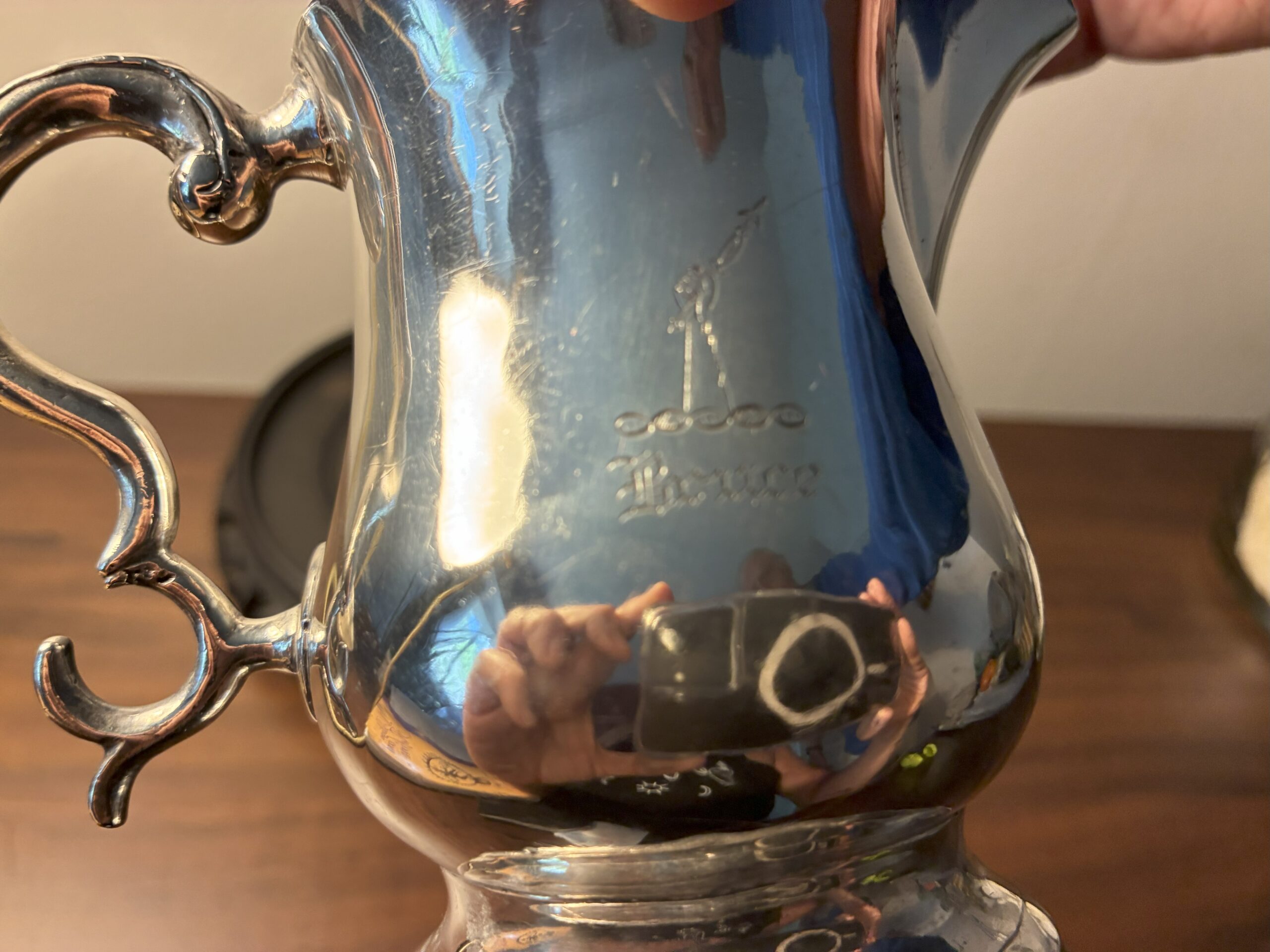
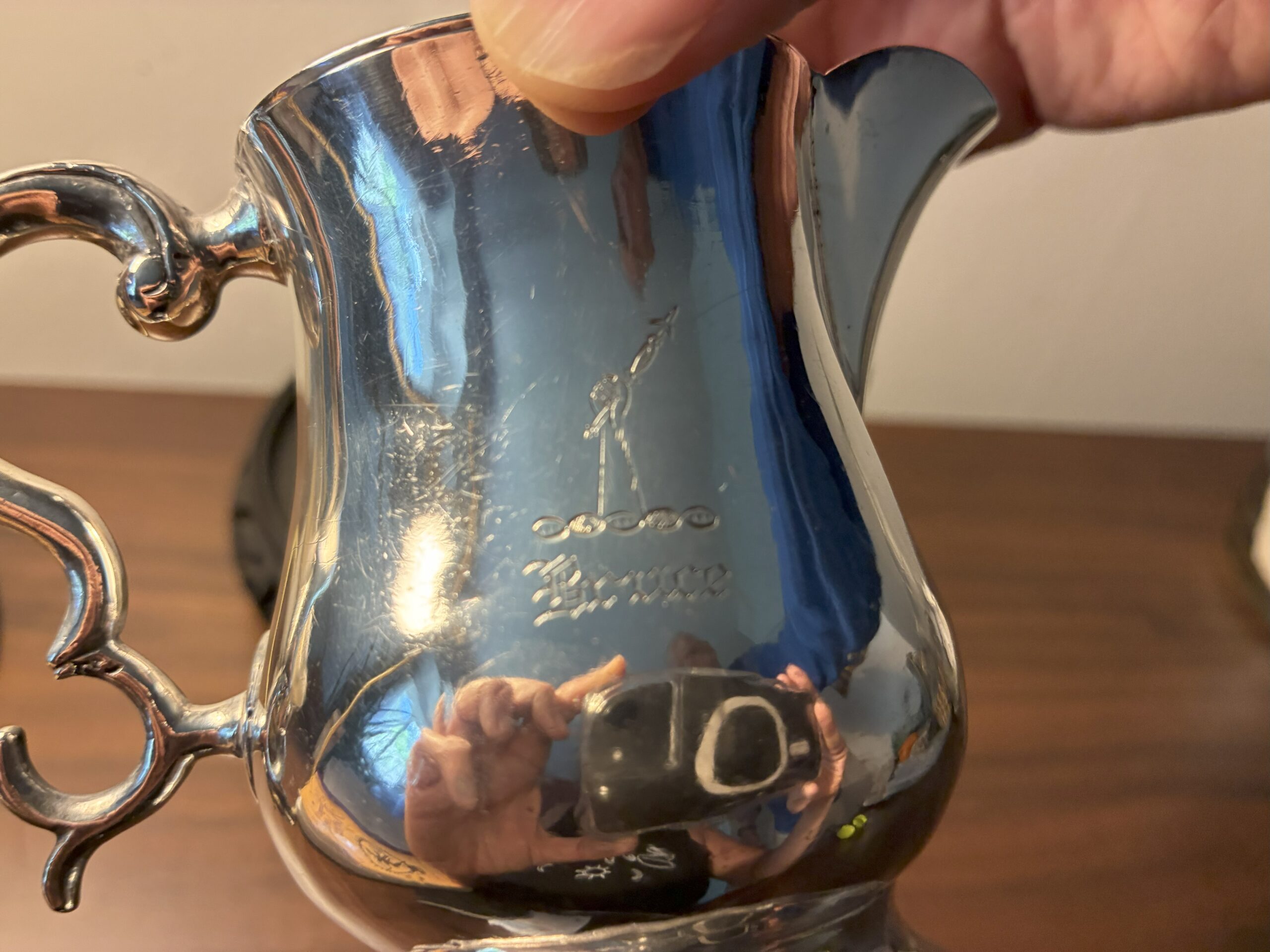
The silver creamer has the Bruce family arms engraved on one side and the Key family arms on the other side. Normand’s father, Charles Bruce, was a glazier (glass tradesman) in Scotland. The Bruce family arms match the design on Charles Bruce’s Trade Card which can be found at the British Museum. The Key family arms on the creamer match a description found in a Key Family history by Christopher Johnston in a 1910 Maryland Historical Magazine article. Johnston describes it as; “…a griffin’s head couped at the breast, wings addorsed argent, holding in the beak a key…”. According to Samantha Dorsey of Heirloom Consulting, it could be possible that these arms were added later in the late 1800’s, a common practice with these types of silver.
The creamer offers a connection, one to a distant past in rural Carroll County from a home next to Big Pipe Creek called Myrtle Hill. A past where an enterprising Scotsman named Normand married a woman from a prominent family named Susannah and raised their family. It passed down through the generations to their daughter Elizabeth Key Scott, then to their granddaughter Elizabeth Maynadier Bruce Boyle, to their great grandson Joseph Bernard Boyle, to their 2x great grandson, Norman Bruce Boyle, to their 3x great granddaughter, Elizabeth Maynadier Scott Boyle Neal, and finally to its current custodian, their 4x great granddaughter Susannah Gardiner Key Neal. With great care, it has managed to survive and connect each family member through the years.
Susannah Gardiner Key Neal says “It is a really sweet little creamer. I love the curvy handle and that it fits my hand perfectly and was held by my grandparents, Normand Bruce and Susanna Gardiner Key, my namesake. It comforts me to know that so many of my family members still live in the same community and have for over 250 years.”
At the one-year countdown to our nation’s Semiquincentennial (250th) anniversary in 2026, it is important to think about family treasures like the Bruce family creamer. These stories are not only a part of our history as a nation but also a story of us. The Bruce family history and more detailed images of the silver creamer will soon be featured on Carroll 250’s digital exhibit launching this summer as part of the Historical Society of Carroll County’s digital library project.